
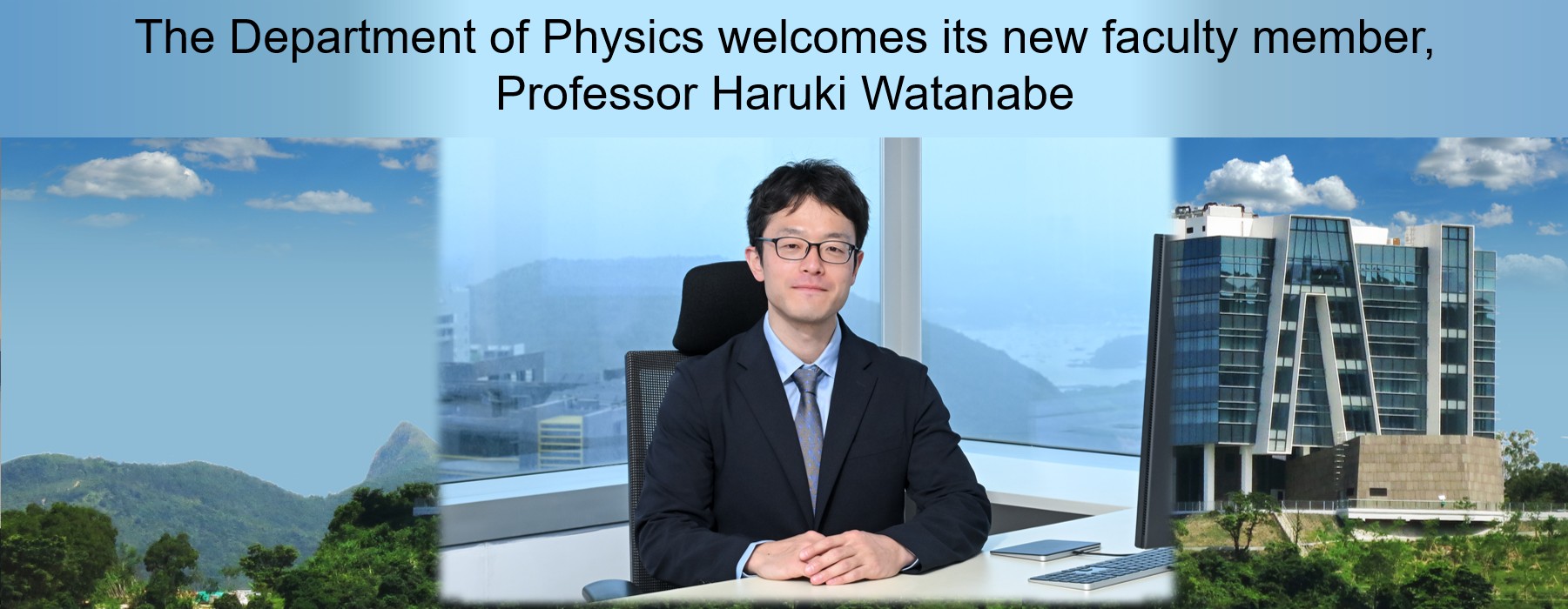
The Department of Physics is proud to welcome its newest faculty member, Prof. Haruki Watanabe.
Professor Watanabe received his B.A. and M.Sc. in Physics with honors from the University of Tokyo. He earned his Ph.D. in Physics from the University of California, Berkeley in 2015 under the supervision of Professor Ashvin Vishwanath. Following his graduation, he was a Pappalardo Postdoctoral Fellow at the Massachusetts Institute of Technology. Before joining HKUST as Professor of Physics and HKUST Jockey Club Institute of Advanced Study Professor, he served as a Lecturer and subsequently as an Associate Professor at the University of Tokyo.
Professor Watanabe is a theoretical physicist interested in uncovering universal properties of quantum many-body systems from a symmetry perspective. His research spans several interconnected areas. He established a unified counting rule for Nambu-Goldstone bosons in nonrelativistic systems and proved the absence of quantum time crystals. He also developed a symmetry-based framework for diagnosing band topology and discovered fractional corner charge in the cubic crystal of NaCl in collaboration with Prof. Hoi Chun Po in the HKUST Department of Physics. Furthermore, he recently proved rigorous bounds on dynamical critical exponents and finite-size gaps in gapless frustration-free quantum many-body systems. His work has been recognized with numerous awards, including the New Horizons in Physics Prize from the Breakthrough Prize Foundation (2022), the Commendation for Science and Technology from the Minister of Education, Japan (2024), and the Particle Physics Medal (2025), among others.
Recently, Professor Watanabe has developed a keen interest in the phase diagram of water, conducting active research on the thermodynamic transitions of high-pressure ice phases. His recent findings challenge conventional frameworks, addressing a fundamental question in condensed matter physics: how phases of matter can be classified in general, beyond the established paradigms of spontaneous symmetry breaking and topological order. We look forward to his future discoveries and continued success at HKUST.