
News & Events
2026-05-06
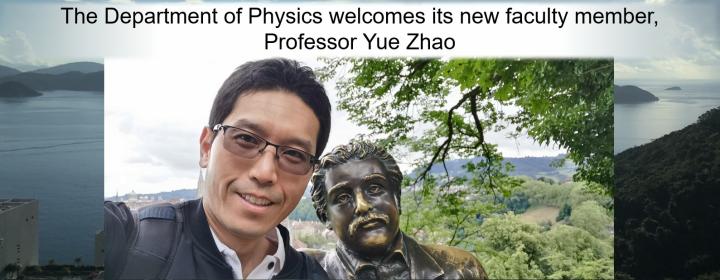
Prof. Yue Zhao (left) and Albert Einstein (right)
The Department of Physics is proud to welcome its newest faculty member, Associate Professor Yue Zhao.
Professor Zhao completed his undergraduate studies at Peking University and received his Ph.D. in physics from Rutgers University. Prior to joining HKUST, he was a postdoctoral researcher at Stanford University and the University of Michigan, followed by a faculty position at the University of Utah. Currently, Yue conducts research in high-energy physics, searching for new physics beyond the Standard Model, with a particular focus on understanding the nature of dark matter. He employs astrophysical methods, including gravitational wave observatories and the Event Horizon Telescope, as well as quantum sensing techniques, to probe potential signals of new particles and interactions. He also established the LIGO group at HKUST.
Read more

2026-04-14
The Department of Physics is proud to welcome its newest faculty member, Prof. Haruki Watanabe.
Professor Watanabe received his B.A. and M.Sc. in Physics with honors from the University of Tokyo. He earned his Ph.D. in Physics from the University of California, Berkeley in 2015 under the supervision of Professor Ashvin Vishwanath. Following his graduation, he was a Pappalardo Postdoctoral Fellow at the Massachusetts Institute of Technology. Before joining HKUST as Professor of Physics and HKUST Jockey Club Institute of Advanced Study Professor, he served as a Lecturer and subsequently as an Associate Professor at the University of Tokyo.
Professor Watanabe is a theoretical physicist interested in uncovering universal properties of quantum many-body systems from a symmetry perspective. His research spans several interconnected areas. He established a unified counting rule for Nambu-Goldstone bosons in nonrelativistic systems and proved the absence of quantum time crystals. He also developed a symmetry-based framework for diagnosing band topology and discovered fractional corner charge in the cubic crystal of NaCl in collaboration with Prof. Hoi Chun Po in the HKUST Department of Physics. Furthermore, he recently proved rigorous bounds on dynamical critical exponents and finite-size gaps in gapless frustration-free quantum many-body systems. His work has been recognized with numerous awards, including the New Horizons in Physics Prize from the Breakthrough Prize Foundation (2022), the Commendation for Science and Technology from the Minister of Education, Japan (2024), and the Particle Physics Medal (2025), among others.
Recently, Professor Watanabe has developed a keen interest in the phase diagram of water, conducting active research on the thermodynamic transitions of high-pressure ice phases. His recent findings challenge conventional frameworks, addressing a fundamental question in condensed matter physics: how phases of matter can be classified in general, beyond the established paradigms of spontaneous symmetry breaking and topological order. We look forward to his future discoveries and continued success at HKUST.
Read more
2025-12-16
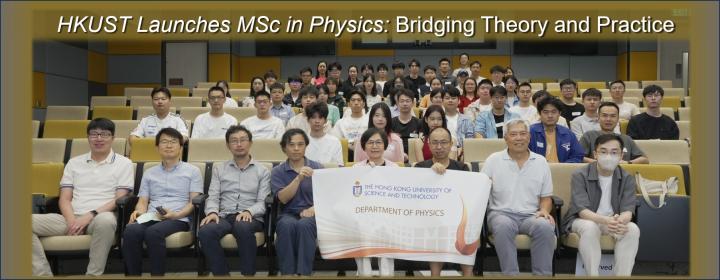
The Hong Kong University of Science and Technology proudly introduced its Master of Science (MSc) in Physics program in the 2025/26 academic year, welcoming its inaugural cohort of 61 students from diverse academic backgrounds in physics, mathematics, computer science, and engineering. This strong start reflects the growing demand for advanced training in scientific computing and advanced materials physics and technology, which form the program’s core pillars.
Program Vision and Academic Strengths
The MSc in Physics program is designed to upgrade and strengthen students’ knowledge in fundamental physics while providing specialized training in emerging areas. Students can choose from two concentrations:
Advanced Materials Physics and Technology – Explore next-generation materials for electronics, optoelectronics, and quantum devices, with exposure to fabrication techniques and device design/characterization.
Scientific Computing – Gain practical experience in simulation and programming tools to solve complex physics and real-world problems, preparing graduates for computationally intensive roles.
The program emphasizes critical thinking, problem-solving, and presentation skills, which are highly sought after by industry and commerce. Graduates will be equipped for careers in technology, research, and innovation, or can use the program as a stepping-stone toward a research postgraduate degree.
Curriculum Highlights
The program offers a well-structured curriculum combining core foundations with advanced electives:
Core Courses – Data Analysis for Physics, Contemporary Physics, and MSc Physics Seminars provide essential skills in modern physics and research communication.
Elective Courses – Students can explore specialized topics in advanced materials such as Semiconductor Devices and Processing, Quantum Materials and Technologies, Metamaterials and Applications, and Topological and 2D Materials. For Scientific Computing, including courses in Computational and Simulation Tools, Computational Methods in Science, and Applications of Artificial Intelligence in Science. This balanced approach ensures students gain both a strong theoretical foundation and practical expertise in cutting-edge areas of physics.
Fostering a Vibrant Learning Community
To ensure a smooth transition into graduate studies and to build lasting connections from day one, the program has curated a rich calendar of orientation, networking, and hands-on immersion activities.
The journey began with a warm August Welcome Reception, where students were introduced to the program’s vision, curriculum, and faculty expertise through lively small-group discussions on research interests and career aspirations. In September, a scenic one-day boat trip to Tap Mun and Tung Ping Chau offered a relaxed setting for team-building and informal conversations among students and faculty.
Beyond these social highlights, students will join a full-day visit in January 2026 to advanced physics laboratories and leading research facilities in the Greater Bay Area, including the Shenzhen Institutes of Advanced Technology (SIAT) and the China Spallation Neutron Source (CSNS) in Dongguan. These experiences let students explore state-of-the-art facilities, meet active researchers, and discover potential thesis or collaboration opportunities.
As part of our ongoing efforts to strengthen ties between academia and industry. This fall, we hosted an inspiring talk by one of our part-time students working in the financial sector, sharing practical strategies for breaking into finance with a science or engineering background—a session that was enthusiastically received. More of the expert sharing sessions with experts from different fields are planned for Spring semester.
Through these thoughtfully designed initiatives, the MSc in Physics program is building a close-knit, supportive, and intellectually vibrant community that will accompany students throughout their studies and into their future careers.
Who Could Benefit?
The MSc in Physics is ideal for: Aspiring Physicists seeking deeper understanding of core concepts and applications. Technology Enthusiasts interested in cutting-edge materials science and quantum technologies. Computational Scientists aim to master simulation and modeling techniques. Career changers seeking to transition into physics and technology-related roles.
Admission Opens for 2026/27 Intake
With its strong academic foundation, interdisciplinary approach, and collaborative culture, the MSc in Physics program offers a unique platform for students to advance their knowledge and contribute to future innovations. Applications for the 2026/27 intake are now open. Non-local applicants should apply by 15 June 2026, and local applicants by 15 July 2026. For details, visit https://msphy.hkust.edu.hk/ or email msphy@ust.hk.
Read more
2025-12-05
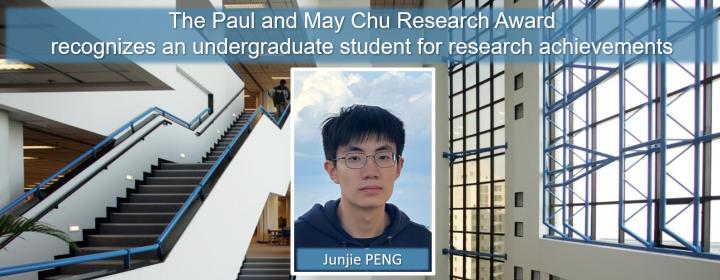
The Department of Physics is pleased to announce the winner of the 2025 Paul and May Chu Undergraduate Research Award. The Paul and May Chu Undergraduate Research Award (Honorable Mention) is awarded to Junjie PENG.
Paul and May Chu Undergraduate Research Award, Honorable Mention – Junjie PENG
“For construction of realistic tight-binding models for layered materials V2X2O-family and symmetry analysis of spin transport and MOKE in altermagnets” under the supervision of Prof. Junwei Liu.
Junjie Peng has conducted focused research in condensed matter physics since joining Prof. Junwei Liu’s group. He independently derived efficient tight-binding models for layered V₂X₂O-family altermagnets to capture their unconventional response properties, performed systematic symmetry analysis to predict novel spin conductivity, and investigated the magneto-optical Kerr effect (MOKE) as a reliable optical fingerprint for detecting altermagnetic order. His discovery will facilitate future studies of altermagnetism and its application in spintronics.
Read more
2025-12-01
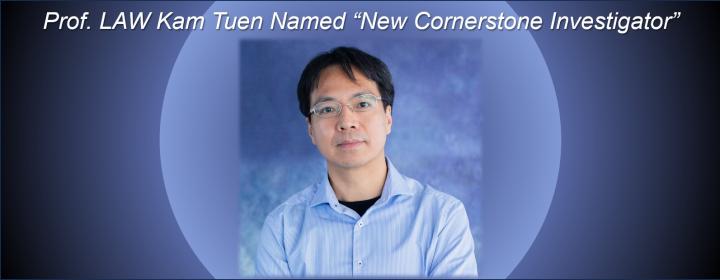
The HKUST Department of Physics is proud to announce that Chair Prof. LAW Kam Tuen of the Department of Physics has been named a “New Cornerstone Investigator“ by the Tencent-funded New Cornerstone Science Foundation. Prof. Law is among 35 distinguished scientists selected this year from across the nation and the sole honoree from Hong Kong.
University Press Releases:
HKUST Prof. LAW Kam-Tuen Named “New Cornerstone Investigator” – Hong Kong’s Only Honoree this Year
科大羅錦團教授獲選「新基石研究員」 成為本年度香港地區唯一獲選者
科大罗锦团教授获选「新基石研究员」 成为本年度香港地区唯一获选者
Read more
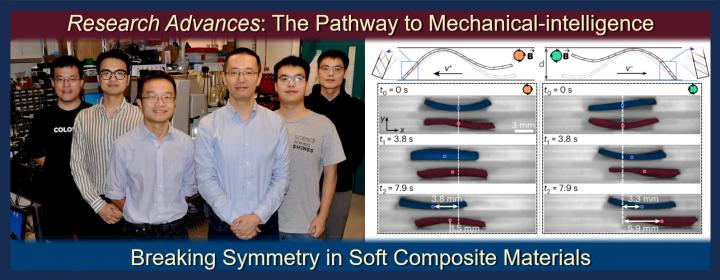
2025-11-28
Interdisciplinary research team members from the HKUST Department of Physics (PHYS) and the HKUST Department of Mechanical and Aerospace Engineering (MAE), from left to right: Dr. Yiqiu Zhao (PHYS), Dr. Shuaihu Wang (PHYS), Prof. Wenqi Hu (MAE), Prof. Qin Xu (PHYS), Mr. Chang Xu (PHYS), and Mr. Hong Wang (MAE).
Publication:
Mechanical non-reciprocity programmed by shear jamming in soft composite solids
University Press Releases:
HKUST Researchers Pioneer Pathway to Mechanical Intelligence by Breaking Symmetry in Soft Composite Materials
科大研究團隊打破柔性複合材料的力學對稱性 開創機械智能新方向
科大研究团队打破柔性复合材料的力学对称性 开创机械智能新方向
Read more
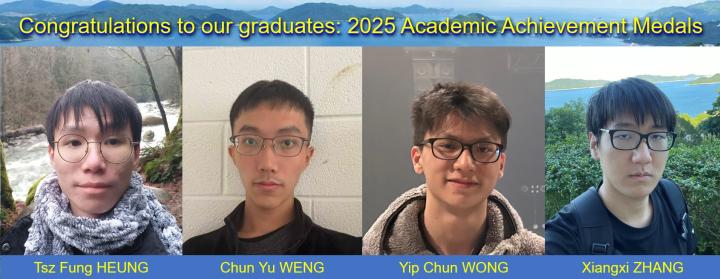
2025-11-21
Congratulations to Tsz Fung Heung, Chun Yu Weng, Yip Chun Wong, and Xiangxi Zhang (l-r) for being awarded 2025 Academic Achievement Medals. The Academic Achievement Medal is the highest academic honor bestowed by the University on outstanding undergraduate students upon graduation. The awarding of the Medal was established in 1994 to recognize graduates whose outstanding academic achievements bring honor and distinction both to themselves and to the University. Only the top 1% of graduates are awarded the Academic Achievement Medal annually. These awards will be presented at the 33rd University Congregation on 29 November 2025. The Department is very proud of all graduates and additionally delighted in the achievements of the Academic Achievement Medal awardees.
Tsz Fung Heung is currently pursuing a Ph.D. in the Department of Physics at Northwestern University with an interest in quantum information. Chun Yu Weng is pursuing his interest in experimental condensed matter physics as a Ph.D. student in the Department of Physics at Cornell University. Yip Chun Wong is a Ph.D. student in the Department of Physics at the University of Toronto. His interest is in theoretical condensed matter physics. Xiangxi Zhang is pursuing an M.Phil. degree in the Department of Physics at HKUST with a focus on theoretical condensed matter physics.
Read more
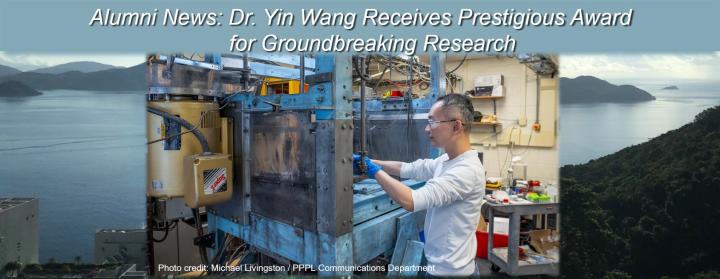
2025-10-30
The Department of Physics at HKUST proudly announces that alumnus Dr. Yin Wang, who earned his PhD in 2018 under the supervision of Professor Penger Tong, has been awarded the 2025 John Dawson Award for Excellence in Plasma Physics Research by the American Physical Society. Dr. Wang, currently a Staff Research Physicist at the Princeton Plasma Physics Laboratory (PPPL) — a U.S. Department of Energy national laboratory managed by Princeton University, achieved a significant milestone by successfully confirming the magnetorotational instability (MRI) in a laboratory setting using liquid-metal flows. The MRI is widely believed to be the driving mechanism behind the evolution of accretion disks, which destabilize orbiting material and cause it to spiral inward toward central objects such as black holes or young stars. This groundbreaking work made by Dr. Wang and coworkers at PPPL not only validates a long-hypothesized theory but also enhances our understanding of astrophysical phenomena such as black hole accretion and star formation. Dr. Wang credits his rigorous training at HKUST for shaping his scientific approach and contributing to his research success. Congratulations to Dr. Wang for this remarkable achievement!
Read more
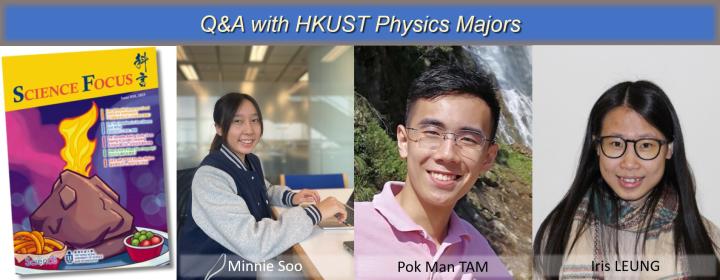
2025-10-23
In the most recent issue of Science Focus, an HKUST physics major interviewed three other physics majors (one current and two alumni) about why they chose physics and how they feel about the career prospects for physics graduates.
The interviewer was Sam FAN, a physics undergraduate in year 4 who is currently doing a one-year internship with the Hong Kong Observatory. One interviewee was Minnie SOO, a year-4 physics major with an extended major in artificial intelligence. The others were two alumni: Dr. Pok Man TAM (BSc Physics 2018), now a postdoctoral fellow at Princeton University working on theoretical condensed matter physics; and Dr. Iris LEUNG (BSc Physics 2017), now a hedge-fund research engineer.
The interview topics include why they were inspired to major in physics, how their attitudes have changed over the years, their views on stereotypes about physics, and how they perceive the current job market for physics graduates. Read the full interview here.
Prospective physics students who would like to learn more about our undergraduate programs can find more information here.
Read more
2025-08-21
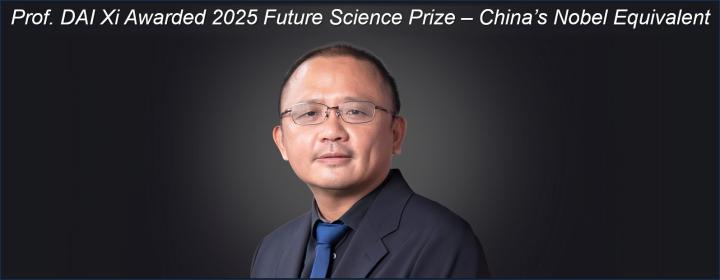
The HKUST Department of Physics is proud to announce the award of the Future Science Prize by the Future Science Prize Foundation to our colleague, Prof. Xi DAI, which he shared equally with Prof. Zhong FANG (Institute of Physics, Chinese Academy of Sciences) and Prof. Hong DING (Tsung-Dao Lee Institute, Shanghai Jiao Tong University),
“for their contributions to the computational prediction and experimental realization of topological electronic materials.”
University Press Releases:
HKUST Scholar Prof. DAI Xi Awarded 2025 Future Science Prize – China’s Nobel Equivalent
香港科大學者戴希教授問鼎有「中國諾貝爾獎」之稱的2025未來科學大獎
Future Science Prize:
https://www.futureprize.org/en/laureates/list.html
Read more