

Abstract
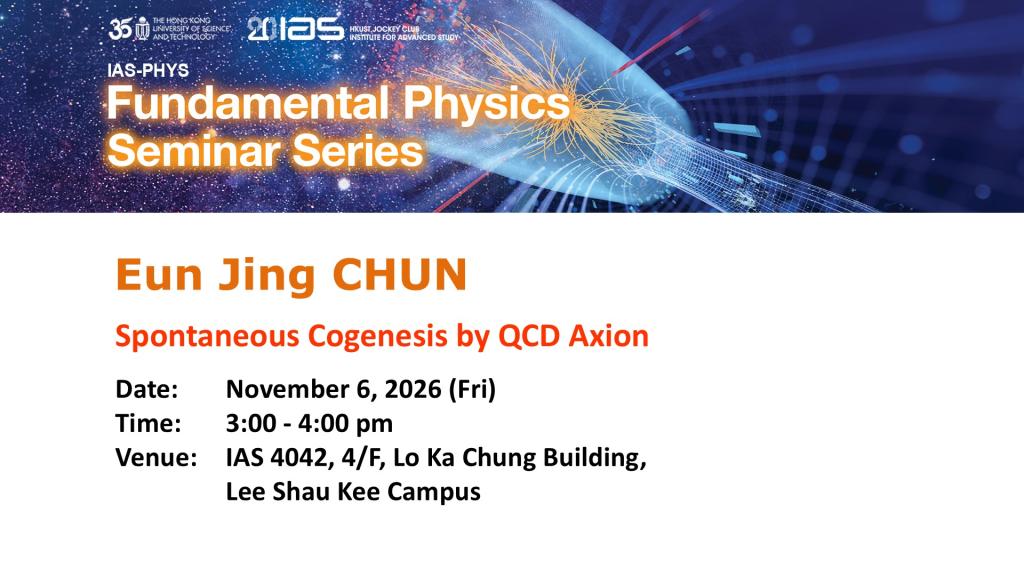
The speaker proposes a unified framework that connects the Peccei-Quinn (PQ) mechanism with a Type-I seesaw sector within the DFSZ axion model augmented by heavy right-handed neutrinos. By utilizing early-time axion rotation driven by Hubble-induced masses and higher-dimensional PQ-violating operators, the speaker demonstrates that the resulting kinetic misalignment naturally and simultaneously produces both the universe's baryon asymmetry and dark matter abundance. He further establishes clear parametric bounds on right-handed neutrino masses and viable Hubble scales required for successful cogenesis. This predictive mechanism successfully generates the observed dark matter and baryon densities while fully respecting solutions to the strong CP problem and current limits on axion isocurvature perturbations.
About the Speaker
Prof. Eung Jin CHUN received his PhD in physics at Seoul National University (SNU), and worked as a research member at the Technical University of Munich (TUM), the International Centre for Theoretical Physics (ICTP), the Korea Institute for Advanced Study (KIAS) and SNU, before he became a faculty member at KIAS in 2002. His research focuses on theories beyond the Standard Model, particularly involving neutrino and dark matter physics in connection with cosmological and astrophysical observations and collider searches.
About the Center for Fundamental Physics
For more information, please refer to https://iascfp.hkust.edu.hk/.
For Attendees' Attention
Seating is on a first come, first served basis.