News & Events

2019-01-03
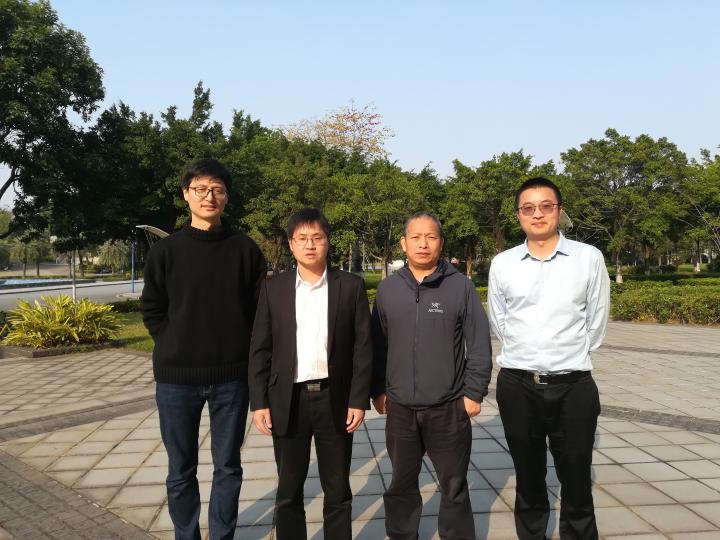
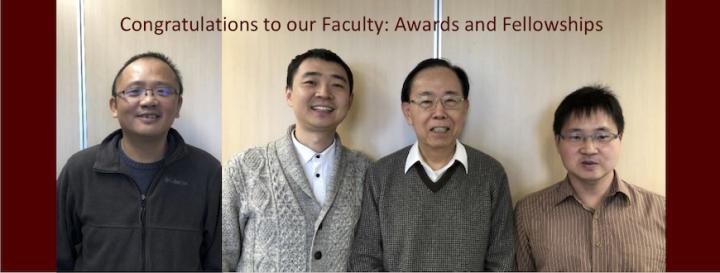
Congratulations to faculty members in the Department of Physics for important recognition of their research achievements (left to right). Prof. Xi Dai was elected Fellow of the American Physical Society (APS) upon nomination by the Division of Condensed Matter Physics. Prof. Dai was recognized by this prestigious Fellowship “for contribution in using ab initio calculations to pinpoint the material systems that realized quantum anomalous Hall effect, the Weyl Fermion, and 3D topological insulators.” The APS Fellowship Program was established to recognize members who have made exceptional contributions to the physics enterprise through outstanding research, leadership or service, or application of physics to science and technology. Each year, no more than 0.5% of the total APS membership is elected for Fellowship after a rigorous and competitive review process.  Prof. Ding Pan was the recipient of a Croucher Innovation Award in 2018. Established in 2012, the Croucher Innovation Awards aim to recognize a small number of exceptionally talented scientists working at an internationally competitive level at a formative stage in their careers. Support from the Croucher Foundation will enable Prof. Pan to undertake the project “First-principles studies of carbon in the deep Earth”. In this Project, he will develop and apply computational and numerical methods from first principles to seek answers to the urgent and fundamental scientific questions relevant to sustainable development, e.g., water science, deep carbon cycle, and clean energy. Prof. Ping Sheng was awarded the 2018 Rolf Landauer Medal by the International Associate for the Science of Electrical Transport and Optical Properties of Inhomogeneous Media (ETOPIM). The Landauer Medal is awarded once every 3 years for excellence in the field of composite science. Professor Sheng received the Medal “for his pioneering research contributions to the electrical transport and acoustic properties of inhomogeneous media that include the notable fluctuation-induced tunneling conduction mechanism and acoustic metamaterial.” Prof. Shengwang Du was elected Fellow of the Optical Society (OSA) “for pioneering contributions in photon-atom quantum interaction, including generation and manipulation of narrowband biphotons, observation of optical precursors, and realization of non-traditional quantum heat engines.” The OSA Fellowship Program was established to recognize those who have served with distinction in the advancement of optics and photonics. The number of Fellows elected each year is limited to approximately 0.5% of the total OSA membership. Read more
2018-11-18
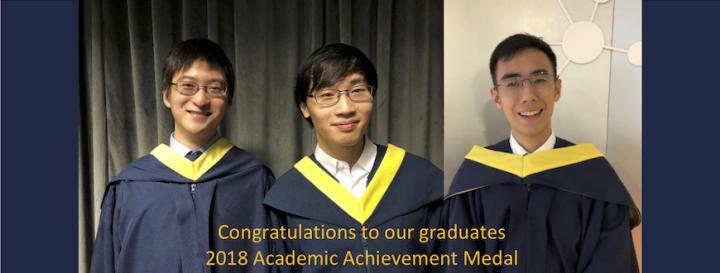
Congratulations to Zhao Cong Chan, Yik Chuen San and Pok Man Tam (l-r) for being awarded 2018 Academic Achievement Medals. The Academic Achievement Medal is the highest academic honor bestowed by the University on outstanding undergraduate students upon graduation. The awarding of the Medal was established in 1994 to recognize graduates whose outstanding academic achievements bring honor and distinction both to themselves and to the University. Only the top 2-3% of graduates are awarded the Academic Achievement Medal annually. These awards were presented at the 26thUniversity Congregation on 15 November 2018. We are proud of all of our graduates, and are especially delighted in the achievements of the Academic Achievement Medal awardees.   Mr. Chan is currently pursuing a Master’s degree in Big Data Technology at HKUST. Mr. San and Mr Tam are currently pursuing PhD degrees at Cornell University in Ithaca, New York, USA and at the University of Pennsylvania in Philadelphia, Pennsylvania, USA, respectively.  Read more
2018-10-03
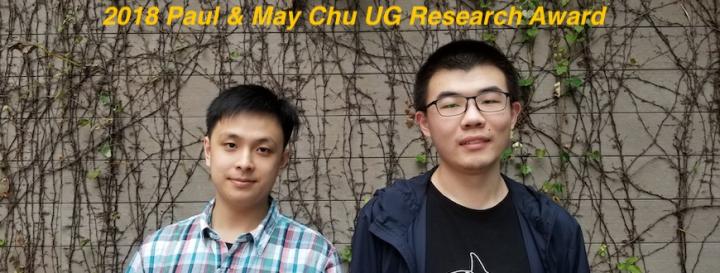
Following the announcement of the Nobel Prize in Physics 2018, we are pleased to announce that the 2018 Paul and May Chu Undergraduate Research Award will be awarded to Tong WANG, and the Honorable Mention will be awarded to Long Him CHEUNG. The Paul and May Chu UG Research Award is the highest honor offered by the Department of Physics to recognize outstanding research in physics conducted by an undergraduate student.  Tong WANG has worked on experimental soft matter physics  under the supervision of Prof. Ophelia TSUI at HKUST. He demonstrated that the thickness dependence of the glass transition temperature of copolymer films can be controlled by strategically adjusting the composition of the copolymer. Long Him CHEUNG has worked on the collective behavior of active Brownian particles under the supervision of Prof. H. Eugene STANLEY at Boston University and on complex network under the supervision of Prof. Kwok Yip SZETO at HKUST.  For the details of the award, please check the HKUST Physics UG Scholarship website: http://www.phys.ust.hk/scholarship/ 
 
Congratulations to Tong WANG and Long Him CHEUNG!
 
Sincerely yours, Prof. Penger Tong
Head, Department of Physics
The Hong Kong University of Science and Technology Prof. Shengwang Du
Chair, UG Scholarship Task Group
Department of Physics
The Hong Kong University of Science and Technology Read more
2018-04-19
The Mr. Armin and Mrs. Lillian Kitchell Undergraduate Research Award was established in 2010 to recognize students who demonstrate outstanding performance in the University-wide Undergraduate Research Opportunities Program (UROP) and to promote research culture among undergraduate students.  Mr. Lingbang ZHU was overall Champion of the Mr Armin and Mrs Lillian Kitchell Undergraduate Research Award competition in 2018. Mr. Zhu is a 3rd-year physics undergraduate student who carries out research under the supervision of Prof. Shengwang Du. In his project work “Generating Narrowband Entangled Photon Pairs from a Hot Atomic Vapor Cell”, Lingbang applied a spatially tailored hollow optical pumping beam to suppress uncorrelated noise photons from resonance fluorescence and achieved bright narrowband (2.9 MHz) biphoton generation from a Doppler-broadened hot rubidium atomic vapor cell. Lingbang’s result will have important applications in quantum information and quantum communication. Since joining Prof Du’s group in September 2015, Lingbang has coauthored 2 research papers: Applied Physics Letters 110, 161101 (2017) as first author, and Nature Communications 7, 12783 (2016) as contributing author. The First Runner-Ups of the Mr Armin and Mrs Lillian Kitchell Undergraduate Research Award competition were Mr. Chun Tin YIP and Mr. Da Wei David REN. Mr. Yip and Mr. Ren are both 4th-year physics students. Mr. Yip carried out his award winning research “Random Walk on Complex Network and Application to Numerical Simulation for Statistical Physics” under the supervision of Prof. K.Y. Szeto. Mr. Ren carried out his award winning research “Confinement Effects on a Planar Dense Wake” under the supervision of Prof. Larry Li in the Department of Mechanical and Aerospace Engineering. The Second Runner-Up of the Mr Armin and Mrs Lillian Kitchell Undergraduate Research Award competition was Mr. Juntao WANG. Mr. Wang is a 4th year physics undergraduate student who carried his award winning research out under the supervision of Prof. Michael K.Y. Wong. In the project entitled “Dynamics of Housing Prices”, Mr Wang applied Gaussian Process, which is a kernel method in machine learning, to investigate the dynamics of Hong Kong housing prices. By analyzing the frequency components in the auto-covariance function of the change rate of the housing prices, a new kernel function is introduced to characterize the inference relations between the data. Using the new kernel function, the Gaussian Process gives more accurate and reliable prediction of the future trends of the Hong Kong housing prices, compared with using other popular kernel functions. Mr. Wang’s previous research was published in the Proceedings of Complex Networks 2017 as contributing author and the Proceedings of the International Conference on Web Intelligence, WI’17 as first author. Read more
2018-02-25
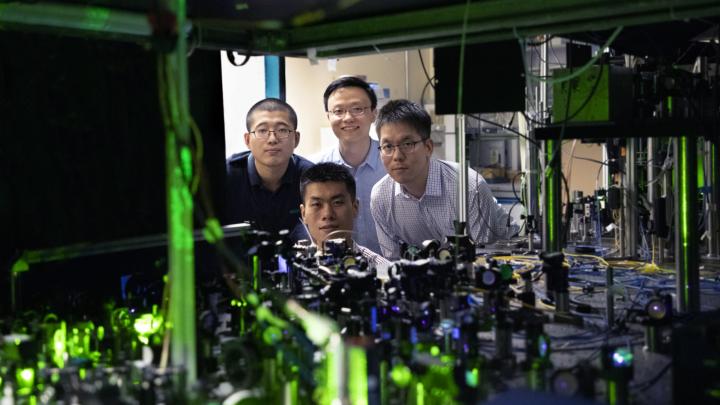
A long-term goal for chemists is to find precise, efficient, and sustainable methods to manipulate chemical reactions at the atomic level. The popular methods include heat, light, electricity, and even ultrasound. Recently, another approach arouses great interest: mechanochemistry or mechanical chemistry, which can be viewed as a hybrid between mechanical processing and chemistry.  It has several advantages: less energy consumption and also more environmental friendly, because it requires little or even no solvent. In conventional solvent-based synthetic methods, the solvents usually have to be heated and cannot be easily disposed.  In a paper published in Nature on 21 Feb 2018, for the first time, scientists selectively triggered redox reactions and cut chemical bonds by simply using mechanical pressure. They used the smallest diamonds in nature and other super-hard specks to design so called “molecular anvils”, which can squeeze and twist molecules delicately. This method opens new possibilities to synthesize commercial materials and pharmaceuticals, and to conduct energy-intensive reactions for sustainable development, e.g., the reduction of carbon dioxide and nitrogen. This paper reports a remarkable cooperative effort among 11 laboratories in four countries. The contributor from Hong Kong, China is Prof. Ding Pan, who is a co-first author responsible for computational studies in this work. The computational simulations and modeling provide the mechanisms of mechanically triggered reactions at the atomic scale. The detailed understanding will help scientists to apply the method to other systems. Link to the paper in Nature: Sterically controlled mechanochemistry under hydrostatic pressure, Hao Yan, Fan Yang, Ding Pan, Yu Lin, J. Nathan Hohman, Diego Solis-Ibarra, Fei Hua Li, Jeremy E. P. Dahl, Robert M. K. Carlson, Boryslav A. Tkachenko, Andrey A. Fokin, Peter R. Schreiner, Giulia Galli, Wendy L. Mao, Zhi-Xun Shen & Nicholas A. Melosh, Nature 554, 505–510 (2018). The work receives massive media coverage. Some technical ones are listed below: Nature News and Views: Molecules pressured to react Phys.org: In a first, tiny diamond anvils trigger chemical reactions by squeezing C&EN: Pressure squeezes reduction reactions out of crystals UChicagoNews: Scientists use tiny diamond anvils to put squeeze on materials Prof. Ding Pan is jointly appointed in the HKUST Department of Physics and Department of Chemistry. He joined the University as a member of the interdisciplinary Sustainability Cluster of appointments. His Angstrom group develops and applies computational and numerical methods from first principles to seek answers to the urgent and fundamental scientific questions relevant to sustainable development, e.g., water science, deep carbon cycle, and clean energy. (Contributed by Ding Pan; image courtesy of Peter Allen/University of Chicago) Read more
2018-02-06
A research team led by Prof. Ho Bun Chan, Associate Professor of the Department of Physics at the Hong Kong University of Science and Technology (HKUST), demonstrates experimentally for the first time that the Casimir force can be made to depend non-monotonically on displacement between silicon nanostructures. This finding was published in Nature Photonics in February 2017. In 1948, Dutch physicist Hendrik Casimir predicted that two electrically neutral, conducting planes attract each other due to the boundary conditions imposed on the quantum fluctuations of the electromagnetic field. This quantum attraction, commonly referred to as the Casimir force, increases rapidly as the distance between the planes decreases. It becomes the dominant interaction between neutral components at the nanoscale. In the last two decades, a series of experiments have verified the existence of this tiny force. The vast majority of the experiments, however, involved simple geometries such as a sphere positioned close to a plate. In these configurations, the attractive Casimir force increases monotonically as the separation is decreased. Recently there have been much efforts in controlling the sign of the Casimir force. In particular, the ability to generate repulsive Casimir forces would open new opportunities in preventing the malfunction of nanomechanical devices due to stiction, which refers to the adhesion of mechanical components upon contact. Using nanofabrication techniques, Prof. Ho Bun Chan’s research group constructed two silicon components with nanoscale protrusions and measure the Casimir force between them at cryogenic temperatures. As the separation between the components are changed with an on-chip actuator, the slope of the Casimir force is found to reverse sign. In addition, they observed a “Casimir spring” effect, where quantum fluctuations lead to confinement of nanomechanical motion. The findings are in good agreement with calculations from the collaborating theory teams of Prof. C. T. Chan of HKUST and Prof. A. W. Rodriguez of Princeton University. HKUST PG students involved in this work include Lu Tang, Mingkang Wang and Henry Ng. This experiment serves as a first step in exploiting the Casimir force between components of complex geometry in nanomechanical systems. For more information, please check: https://www.nature.com/articles/nphoton.2016.254 Read more