News & Events
2021-08-06
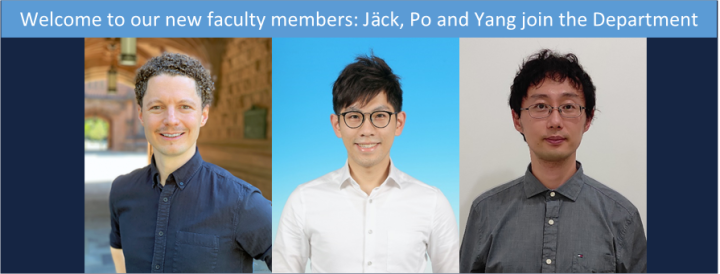
The Department of Physics is proud to welcome three new faculty members:
Assistant Professor Berthold Jäck obtained his diploma degree with distinction from Würzburg University, Germany in 2011 and his Dr. sc. in physics from the Ecole Polytechnique Fédérale de Lausanne, Switzerland in 2015. Prior joining HKUST, he was a postdoctoral fellow of the Alexander-von-Humboldt foundation at Princeton University. His research interest in centered around the microscopic investigation of correlated and topological electronic phases in low-dimensional quantum materials.
Assistant Professor Hoi Chun (Adrian) Po received his Bachelor's degree in Physics at The Chinese University of Hong Kong, and Ph.D. in Physics at the Harvard University. He was a Pappalardo Postdoctoral Fellow in Physics at the Massachusetts Institute of Technology before joining HKUST. His main research interest is condensed matter theory, and in particular on the interplay between symmetries and topology in quantum materials.
Associate Professor Sen Yang received his Bachelor's degree in Physics at Tsinghua University in Beijing, and Ph.D. in Physics at the University of California, San Diego. Prior to joining HKUST, he was a postdoctoral researcher at the University of Texas at Austin and subsequently at the University of Stuttgart. Most recently, he was also an assistant professor in the Chinese University of Hong Kong. His research interest is quantum optics based on solid-state systems, and in particular developing quantum information technologies with nitrogen vacancy centers in diamond.
Read more
2021-06-21
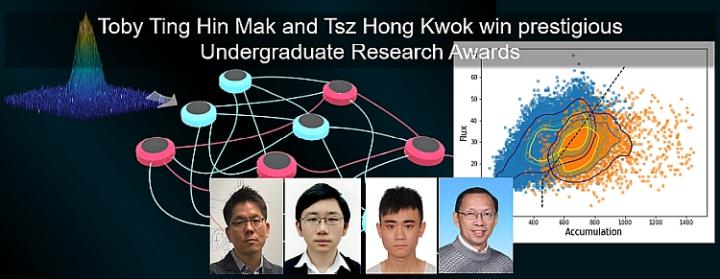
Toby Ting Hin Mak and Tsz Hong Kwok win prestigious Mr Armin and Mrs Lillian Kitchell Undergraduate Research Awards 2021
The Mr. Armin and Mrs. Lillian Kitchell Undergraduate Research Award was established in 2010 to recognize students who demonstrate outstanding performance in the University-wide Undergraduate Research Opportunities Program (UROP) and to promote research culture among undergraduate students.
Mr. Toby Ting Hin MAK won Champion of the Mr Armin and Mrs Lillian Kitchell Undergraduate Research Award competition in 2021. Mr. Mak, a 3rd-year Physics IRE student, has explored the machine learning aided analysis of quantum simulation experiments under the supervision of Prof. Gyu-Boong Jo since February 2019. In the Prof.Jo's group, Mr. Mak developed a machine learning protocol for analyzing the topological nature of the synthetic quantum system, resulting in unprecedented measurement sensitivity. Mr. Mak's significant contribution to the cutting-edge quantum simulation experiment has been evidenced by several conference papers and a journal paper to be submitted as the leading author.
The Second Runner-Up of the Mr Armin and Mrs Lillian Kitchell Undergraduate Research Award competition was Mr. Tsz Hong KWOK. Mr. Kwok is a 4th year physics undergraduate student who carried out his award-winning research under the supervision of Prof. Michael K.Y. Wong. In Prof. Wong’s undergraduate research group on “Latency Prediction in the Taiwan Highway System”, he played a leading role in screening the relevant data, exploring their applicability, and integrating them into a workable system. He explored the pre-clustering of the traffic data before feeding them the learning machines, resulting in around 10% improvement. He presented his work in two international conferences, in Singapore and Hong Kong respectively.
Read more
2020-12-31
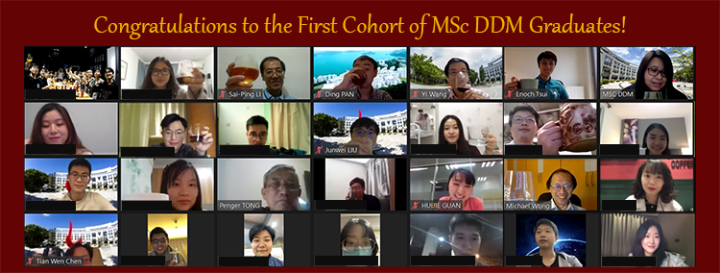
Congratulations to the First Cohort of MSc DDM Graduates: Meeting the Worldwide Demand for Data-Driven Modeling Skills
Congratulations to the first cohort of 47 graduates from the MSc Program in Data-Driven Modeling (MSc-DDM)!
The MSc-DDM program is jointly offered by the Departments of Physics and Mathematics. The program was designed to meet the pressing demand in today’s world for human resources in the areas of data-driven modeling, including hardware, software, services, infrastructure, information, and digital business. Prof. Michael Wong, who is the founding Program Director, states that the design of the MSc DDM program “bridges the gaps between theory, practice, and techniques.”
Admission to the program is very selective, having attracted interest of hundreds of applicants with strengths in mathematics, statistics and engineering. Our graduates are in high demand, with a 100% placement rate in several sectors in Hong Kong, Shenzhen, Guangzhou, Shanghai, and London. The training they received in the MSc-DDM program prepared them to excel in positions with titles such as Algorithm Engineer, Administrative Officer, Data Analyst, Product Manager, Programmer and Risk Management.
This year, MSc-DDM is selected by the University Grants Council to be part of the Targeted TPG Programmes Fellowships Scheme to nurture more talents to pursue further studies in priority areas conducive to the development of Hong Kong. Local students, both full-time and part-time, who are admitted to the MSc-DDM program in the 2021-22 intake are eligible to apply to the Fellowship Scheme. Part of the tuition fees will be subsidized by the fellowships subject to a cap of HK$120,000 for successful students.
Visit the MSc-DDM program website to learn more about the program and admission details, and let MSc-DDM be the gateway to your future success!
For enquiries, please contact:
Florence Cheng
Tel: +852 2358 7354
Email: mscddm@ust.hk
Read more
2020-11-26
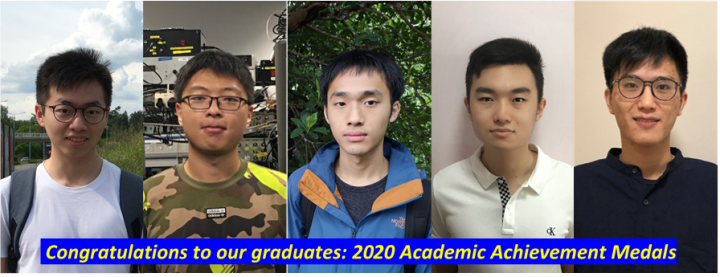
Congratulations to Chun Yu Chow, Bohan Li, Shing Yan Li, Wai Ting Tai and Weijun Yuan (l-r) and San Yu Lai (not pictured) for being awarded 2020 Academic Achievement Medals. The Academic Achievement Medal is the highest academic honor bestowed by the University on outstanding undergraduate students upon graduation. The awarding of the Medal was established in 1994 to recognize graduates whose outstanding academic achievements bring honor and distinction both to themselves and to the University. Only the top 2-3% of graduates are awarded the Academic Achievement Medal annually. These awards were presented at the 27th University Congregation on 8 November 2018. We are proud of all of our graduates, and are especially delighted in the achievements of the Academic Achievement Medal awardees.
Chun Yu Chow is pursuing a Ph.D. degree in Physics at the University of Illinois at Urbana-Champaign. San Yu Lai is pursuing an M.Phil. degree in Linguistics and Applied Linguistics at Peking University. Bohan Li is pursing a Ph.D. degree in Physics at Caltech. Shing Yan Li is pursuing a Ph.D. degree in Physics at MIT. Wai Ting Tai is pursuing a M.Sc. degree in theoretical physics within the Perimeter Scholars International Program at the Perimeter Institute. Weijun Yuan is pursuing a Ph.D. degree in Physics at Columbia University.
Read more
2020-07-24
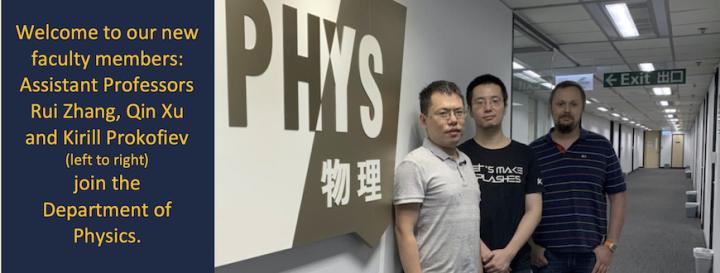
The Department of Physics is proud to welcome three new faculty members:
Assistant Professor Kirill Prokofiev received his Master’s degree from St. Petersburg State Polytechnic University and a Ph.D. from the University of Zurich, both in physics. Prior to joining HKUST he was a Foreign Research Fellow at National Institute for Nuclear Physics, Italy (INFN). He originally joined the Department in 2014 as a Research Assistant Professor and Junior Fellow of the HKUST Jockey Club Institute for Advanced Study. His research interests include experimental studies of the recently discovered Higgs boson, searches for the physics beyond the Standard Model and development of semiconductor silicon detectors for experimental particle physics.
Assistant Professor Qin Xu received his Ph.D. in physics at the University of Chicago in 2015. Prior to joining HKUST, he worked as a postdoctoral researcher in the laboratory of soft and living materials at ETH Zurich. Dr. Qin Xu’s research focuses on soft condensed matter physics. In particular, he is interested in applying advanced optical microscopy in studying mechanics of soft solids and complex fluids.
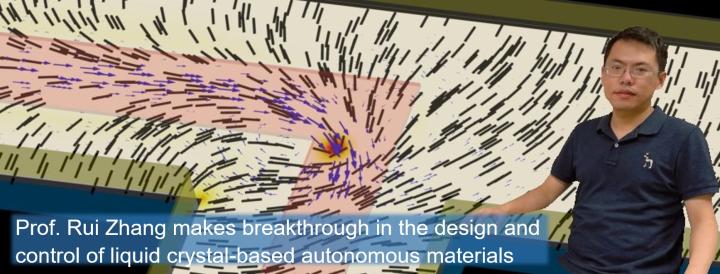
Assistant Professor Rui Zhang received his Bachelor's degree in Physics at Fudan University, and Ph.D. in Physics at the City University of New York. Prior to joining HKUST, he was working at the University of Chicago. His research interest is to use theoretical and numerical tools including data-driven methods to simulate soft matter, including active matter, liquid crystals, and complex fluids, and to design novel materials for practical applications.
Read more
2020-07-24
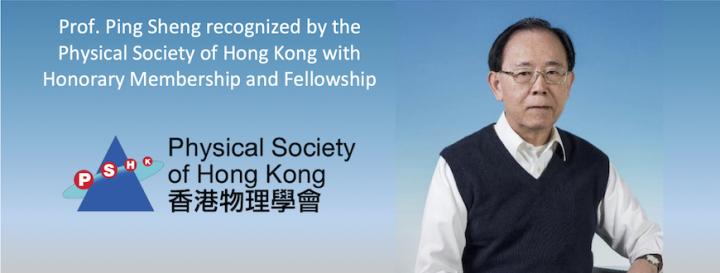
Congratulations to Prof. Ping Sheng for special recognition by the Physical Society of Hong Kong
Prof. Ping Sheng was recognized for his research achievements and contributions to the scientific community by the Physical Society of Hong Kong (http://www.pshk.org.hk/prize-fellow). He was awarded both the highly prestigious Honorary Membership and Fellowship by the Society. Instituted in 2018, this is the first time that both have been awarded to the same person. The citations for these two highly prestigious awards are:
Honorary Membership
For his groundbreaking discoveries and exploration of acoustic metamaterials, soft matter and fluid dynamics; and for his dedication to promoting interdisciplinary and collaborative research in Hong Kong.
Fellowship
For his seminal contributions to a large number of diverse physics problems and outstanding services to the academia of Hong Kong and Greater China.
Read more